There are certain moments in life that reveal who you really are.
For instance, how you behave with people who have no power over you, how much you panic when your phone battery is at 30%, how you behave when someone says, ‘Let’s split the bill equally’ and of course how you order food in a restaurant.
It is not about hunger…there are so many factors that decide how you order food in a restaurant. It is about your personality, how you were brought up, how much money you have spent along the way, how much you have stashed under your proverbial mattress, what is your confidence level and finally who you are married to.
If you really want to understand a person, don’t ask them about their dreams, values, or long-term goals. You don’t even need to look inside their cupboards. Just take them to a restaurant, hand them a menu card and see what they do with it.
Within ten minutes, you will know everything.
You will know who is decisive, who is confused, who wants to be healthy, who is pretending to be healthy, who is secretly checking prices, and who is ordering for Instagram.
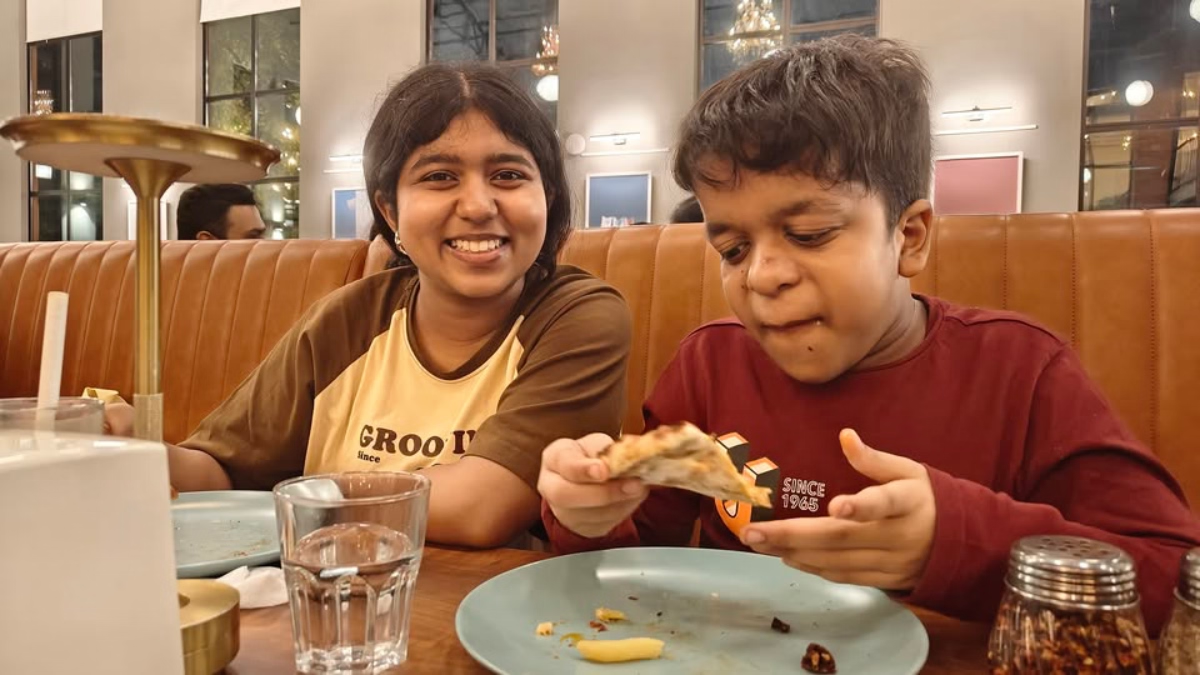
The other day, we went to a restaurant as a family.
Now, to a layman going to a restaurant as a family looks like a seven-step process – exactly the number of steps needed to launch a rocket into space. You reach the restaurant, you enter, you sit, you order, you eat, you pay, you get back home.
But it is hardly that. First, all members of the family – and in our case, that’s me, my wife and two kids – must agree on the location.
If it is lunch my son prefers north Indian (butter chicken and tandoori roti to be specific), my wife prefers Chinese any day, and my daughter prefers South Indian now-a-days because she doesn’t get that in Aurangabad, where she is studying.
As for me, “anything, anywhere is fine.” This has been my motto in marriage as well, which has kept my sanity intact.
Then there is the distance to be considered, availability of parking spots, whether the restaurant has AC, whether it will be crowded, how close its chairs are to the table, how close the tables are to the wall, and finally how costly the whole thing is going to be.
After driving in the general direction of the city (we live on the outskirts) for 20 minutes, you finally choose one restaurant out of compulsion because you are running out of time.
By then, half the hunger is gone. Just three pissed people in the car because one of them had it their way.
And you know us Rajans…we are the type that sacrifice our happiness for the sake of others. Which means, it is never the restaurant I want to go to.
Finally, we reach the restaurant that three out of the four don’t want to be in. If you are not married or don’t have kids…you won’t understand this. This is known as compromise to keep the peace.
The waiter gave us the menu, and he might as well have said: “Now I announce the games open!” because that’s when the real drama begins.
An amateur looks at the menu as a list of food items. It is actually a mirror.
Different people use it differently – some open the menu from the first page, some go directly to the main course, some look at the items with pics, some look for the prices, some look at the ingredients in the item…and some ignore the menu and look for what the next table is eating.
People like me who grew up as lower middle class first look for price. If you ask me in public, I may refuse…but that’s how I am. I will pretend to read the description….“chicken tikka with smoked yoghurt …” but eyes have already gone to the right side….and seen that it costs Rs ₹565.
Rejected.
The next item is “chilli beef fry with copious amounts of green capsicum…” but that’s also priced high at ₹525.
Rejected.
Finally you see “Crispy lotus root tossed in a sticky, sweet-and-spicy glaze….” You haven’t finished reading what it is, but at ₹295 the price looks tempting. Suddenly it looks tasty.
—-X—-X—-
When we were growing up, going to a restaurant was an event. My 12-year-old son has eaten at restaurants more times in 2026 alone than I had by the time I turned 21 and got my first job.
Back then we ate what was given at home. Restaurant visits were rare, and few and far in between. Usually after some exam result, or when some rich uncle came, or if we were travelling and it would be too late by the time we would get home.
And the restaurant was not some place with mood lighting and a man saying, “Hi, my name is Sammy and I’ll be taking care of you tonight.”
A family usually went to one restaurant – your parent’s favourite – and they had one waiter, who wore a shirt and a lungi, had a towel over his shoulder and a notebook in his hand.
He definitely wasn’t a Kevin, Alvin, or Kallis…his name would either be Murugan, Ravi, or Babu.
Back then the restaurant’s menu would be written on the wall, and the prices against them would be old. Most probably written in chalk, but never updated.
But not all items on the wall will be available, so usually the dad would ask: “What all is available?”
And that one question will open a dam of a response because the waiter won’t stop for the next 45 seconds. He rattle it out, “Idli…sambar idli…mini idli….plain dosa….masala dosa….onion dosa…ghee roast…rava dosa…plain uttapam…onion uttapam…ven pongal…rava upma…medu vada…paruppu vadai… Mysore bonda…poori masala…chapati kurma…kuzhi paniyaram…idiyappam with coconut milk, idiyappam with kurma.”
Once he is done, my parents will look at him wondering what to order, and that’s when he adds his punch line, “And after all that…there is filter coffee, tea, and Horlicks!”
Back then nobody said, “I didn’t have carbs last night…so I am going to order a plate of idli.”
Or “Do you have anything that’s purely farm-to-table?”
Or “Yesterday was my leg day, so I think I am going to stick to proteins today.”
And if you asked the waiter what was special, he said, “Everything is excellent” because there were no chef’s specials.
The worst part was, when my dad would look at me and ask, “What do you want?” my mother would butt in and say, “He will have a plate of idli,” when in fact all I wanted was a ghee roast.
As you can see, I grew up with the trauma of not being able to order ghee roast when I wanted. That’s why every time Rekha and I step out for breakfast that’s what I order.
Sometimes, when my parents were generous, they will order two masala vadas and we five would share.
My father will point out to the youngest sister and ask, “don’t we want to order for her?” and my mother will reply, “Nah…she won’t even touch the vada.”
And I swear every time, she would eat one whole vada…leaving the four of us to share the second one.
Back then, ordering food was simple because first there was no menu, and second we kids didn’t have a choice.
Today, Mainland China’s menu has 16 pages, which my son flips through and says, “I want sushi.”
I want to tell him that for raw fish we needn’t have driven 12 kms to the restaurant…he could have just opened our freezer and had some. But I am supposed to be a ‘considerate dad,’ so I consider his request and add that to our order.
At least in the case of Sushi, I know it is raw fish. But the way a dish is described now a days, you don’t even know if they are talking about a dish or a dress Zendaya is going wear and walk down the ramp.
What was earlier just ‘paneer kofta’ is now ‘slow-cooked hand-pulled cottage cheese dumplings in a rich tomato fenugreek paste.’
I don’t understand why where VVS Laxman would be enough, they use Vangipurapu Venkata Sai Laxman.
During my time a 12th pass could have written a menu and also read it. But now a days, I am sure they recruit PhDs in English to create menus – how else do you explain words such as artisanal, rustic, infused, tossed, glazed, charred, smoked, hand-crafted, signature, curated, and elevated get used in a single page?
Yet another thing I have problem with while ordering is the difficult names of some of the items. Back in my times, the names were simple – idli, dosa, upma, pongal etc.
But today, half the battle is not eating the food, it is saying the name of the food without looking like a failure in life.
I mean, who looked at toasted bread with tomato on top and decided to call it Bruschetta?
And worse, it is not even pronounced the way it is written. You say “broo-shetta” and immediately the waiter, with the calmness of a man who has seen many uncivilized people before you, says, “Sir, broo-SKEH-tah.”
Then there is Phở. It has one vowel, one line on top, and still somehow you can mess it up in three ways. So you take a deep breath, point at the menu and say, “One… this.”
Gnocchi which is pronounced “NAW-kee” is another crime against food lovers. The word starts with G, but apparently the G has taken voluntary retirement. Croissant is no better. You say “croissant” like a normal person, and the waiter repeats, “kwa-son,” as if he just returned from Paris after his honeymoon.
And the worst part is, they don’t even correct you rudely. They correct you politely, and you know that deep inside they are smiling at you.
I don’t know how it is in your house, but in our family women order differently.
Women don’t just order food….they manage the meal. They know who will eat what, how much to order, they know which child will say they are not hungry and then eat from everyone’s plate, and they also know that three gravies will be one too much. I am not sure if before going to a restaurant, they sit down alone in a room and prepare for this, but they seem to know.
This is why when the waiter comes, I may still be staring at page three, but Rekha has already solved dinner.
She will say, “We’ll have one hot n’ sour chicken soup two by four, one chicken kebab, one butter chicken, six rotis, and chicken fried rice later.”
I have noticed that if a main course divides the family, the dessert discussion unites it again.
The human stomach is a mysterious organ for it moves from a “I am full” state to “I can have a lot of desserts” state in less than two minutes.
Medical science cannot explain this.
The fathers usually don’t order desserts, but then take a spoon one too many from everybody’s plates.
Finally, the bill comes. Or shall we say lands. At this stage everybody moves from ‘the food was good” to “show me how much it was.”
I pick it up slowly. As a middle class person, I mentally prepare myself before I open the bill, and I open it slightly and look at the bottom first to see how much it was.
The bill says ₹4,863 and I immediately start converting – that’s one month’s electricity bill, two weeks of vegetables, one full diesel tank, and worst part is that it is almost 50 plates of idli. My heart hurts, but I don’t show it.
I remain calm. Because parents must show financial strength even when internally they are bleeding.
On the way back home, the kids are high on spirits and are reviewing the food. And they are already planning which restaurant they should attack next.
“Food was nice.”
“Quantity was less.”
“Chicken was okay.”
“Dessert was best.”
“Next time we should try that other place.”
Next time?
We have not even reached home from this financial incident and already the kids are planning the next expense.
But strangely, both Rekha and I are also happy. Because in that one hour that we sat together, nobody was anywhere else. We were all together in body and mind, with one purpose – be happy together.