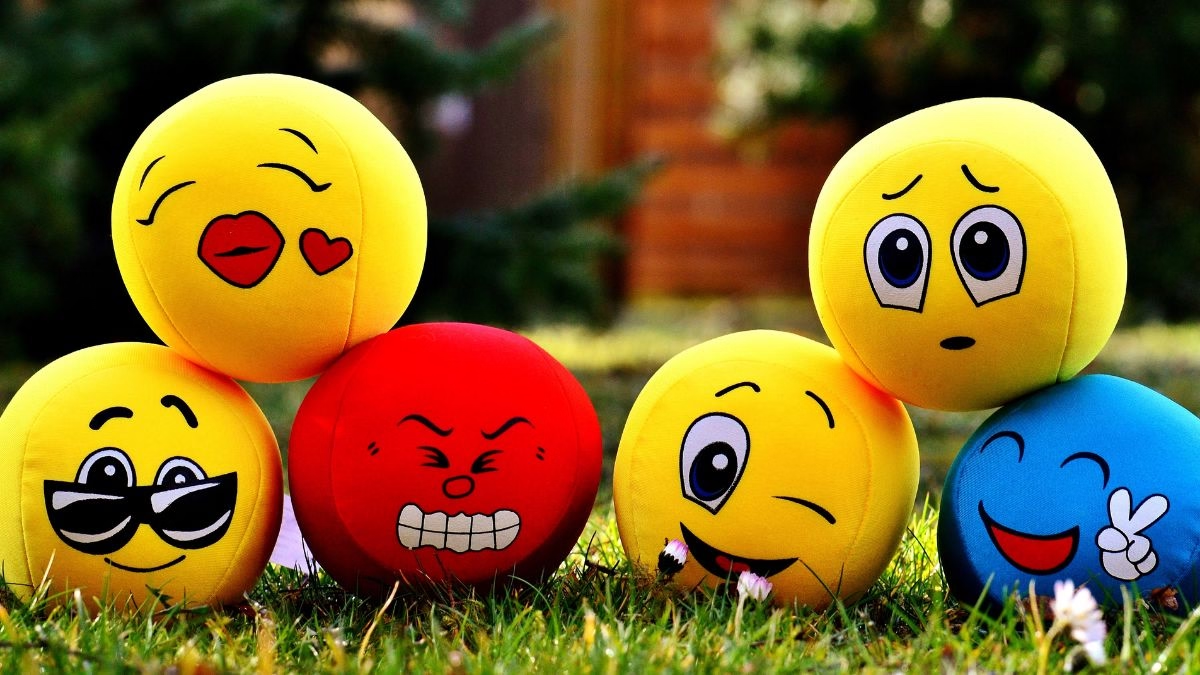
Every WhatsApp group has two kinds of people – those who type and those who live by the emojis.
And please don’t underestimate WhatsApp emojis for they represent ‘full sentences’ typed by people who either love you, judge you, hate you, or simply don’t care about you.
A few decades from now, anthropologists who study cave paintings, ancient inscriptions, architecture, etc., to understand a civilisation will want to study WhatsApp emojis.
Because WhatsApp is to today’s people what the Roman Forum was to Romans and the Athenian Agora was to the citizens of Athens. Because that’s where people meet daily, exchange pleasantries, do business, fight, bless, judge, and ignore.
And inside WhatsApp, nothing is more important than emojis.
For instance, a single folded-hands emoji can mean thank you, sorry, namaste, please stop, I disagree but don’t want to fight, I don’t know what to say, and I don’t want to be rude.
That’s why I thought maybe it is not a bad idea to write about my favourite emojis and how we all use them.
If you are in a group chat with me on WhatsApp, at the end of this article, you will know my secret to good communication. So please just keep it to yourself.
—-X—-X—-
– the folded hands emoji
This is the Amitabh Bachchan of WhatsApp emojis because it can be used in all situations.
You can use it if someone sends birthday wishes, if someone sends condolences, if someone shares photos of a temple, or if someone says “I am leaving the group because nobody respects my opinion.”
This emoji is so flexible that many people who don’t understand the context can also use it.
If someone writes, “I wish I could come and visit you in the hospital …but I was stuck in a meeting” the patient would reply with the folded hands emoji.
And two days later when the patient would die, and the same person messages, “I am sorry I couldn’t come and meet your dad before his untimely death. Will come over later” the patient’s son could use the same folded hands emoji.
So, it cuts across situations and generations.
– the thumbs up emoji
If you are married, this is one of the most dangerous emoji for you. Among men, thumbs up means approval but among women it can mean many things.
When I message Rekha saying, “I will be late,” and she replies with a thumbs up it doesn’t mean that she is OK with it.
It means, “I have received your update. Further action will be taken after you return home.”
In WhatsApp groups, thumbs up is also used to stop the conversation from going further. But many people don’t know how to use it.
We were recently planning a massive group trip to Pollachi in Tamil Nadu, and one of the organizers asked, “Please confirm your availability for 14, 15 and 16 August, mention the number of adults and children, and what you would prefer – vegetarian or non-vegetarian?”
One of the travellers responded with thumbs up emoji. Now we don’t know if he is available on those days, how many of his family members are coming along and what his food preferences are. But in his mind, he has responded.
– the laughing emoji
I use the laughing emoji even when the sentence is not funny…even when I didn’t even smile. And I am sure there are many other there just like me.
Let us be honest….if you are really laughing like that will you be able to hold your mobile properly, select that emoji and then tap on the ‘send’ button?
At best, they would have a hearty laugh, then wipe their eyes, hold their stomach, and maybe type “hahahaha.”
I think the laughing emoji is used when someone has made a joke and you don’t want them to feel bad. This emoji is closest to social service – makes both you and the receiver feel good.
The laughing emojis have a super power…when one user uses it, others are forced to use it.
The moment you send three laughing emojis…5-6 more people will also send them. Not because they also laughed…but because otherwise it would seem as if they didn’t get the joke.
– the slanting laughing emoji
This is used by people who want you to know that they are more amused than normal people.
While the normal laughing emoji conveys that it was a nice joke, the slanting laughing emoji means “I am rolling on the floor laughing.”
But honestly, think about it…how many of you have actually rolled on the floor and laughed at something you read on WhatsApp?
Also, if like me you are a middle-aged man and you roll on the floor laughing, your family will first check whether you are having a stroke.
– the heart emoji
Many Indian men have a problem with the heart emoji because they consider it public display of affection.
In sharp contrast, Indian women use the heart emoji easily. A group full of women usually has more hearts than words. Maybe because they are emotionally literate.
Men are different. If a male friend sends another male a heart emoji, the receiver won’t sleep the whole night.
He will wonder what happened…why did he send me a red heart. Is he okay? Is he drunk? Should I reply a heart emoji or a folding hands emoji?
If I reply a heart emoji, will it end there? Or will he send something more provocative?
Men prefer thumbs up emoji because that is like a handshake, while a heart emoji feels more like a hug.
But send a WhatsApp uncle the Indian National Flag, and he will heart it twice (thankfully WhatsApp doesn’t have that feature).
– the sad emoji
For a long time I didn’t realize this was the sad emoji. I thought this was to be used when we have cold, and have to convey that we have a runny nose.
People use it to express sadness, but when words are risky.
For example when someone sends in, “I am sorry to say that Mr Muralidharan passed away this morning while lifting weights at the gym,” you can’t type back, “I am sad, but I don’t know the deceased well enough to write three lines.”
And that’s why this sad emoji exists…to rescue you from such situations.
But I hate it when some people overdo sadness. Like that instance, when someone’s scooter got stolen from our block, a resident sent six sad emojis. For a moment I thought he was the thief, trying to cover up.
– the clap emoji
The clap emoji is used to play social debt.
If you clapped when someone sent in the group their or their child’s achievement, then they must clap back when you send in your family’s achievement.
Both Rekha and I indulge in these clap exchanges often. The moment our daughter bakes something Rekha will send in a few pics, and get many claps.
Since I don’t like to be in debt, I tell her not to do this. Because now I have to keep waiting for something their kid did. But Rekha doesn’t listen.
Here are a few examples of messages that seem to get the clap emoji:
“Proud to share that Ananya has won second prize in inter-school colouring competition.”
“We are happy to share that Sahil is now a Karate yellow belt.”
These clap emojis are usually followed by short messages such as, “Wonderful,” “Great achievement,” and “Blessings.”
– the fire emoji
The fire emoji represents ‘amazing’ and the younger generation uses it a lot while the older people don’t fully understand it.
If Rhea posts a photo of hers and someone uses a Fire emoji, I understand it means “looking great.”
But some elderly relative may see it and get worried. They may ask, “Why fire? Is everything alright?”
That’s why ladies and gentlemen, if a WhatsApp uncle sends a Fire emoji in a group please check context…it may be his last cry for help from a building on fire.
– the heart eyes emoji
The heart eyes emoji is a diluted version of the red heart emoji and is mostly used on photos of babies, food, sarees, vacations, etc.
I use them often, but most men shy away from using the heart eyes emoji because it shows them as weak. “Emotions? Eww!”
Usually a married man has to be careful before using a heart eye emoji under another woman’s photo.
That’s why, a married man is forced to use a thumbs up emoji or a clap emoji if they receive another woman’s photo.
– the eye roll emoji
The eye-roll emoji is mostly used by women and teenagers. I am yet to see a man use this. Maybe because they don’t do a real-life eye roll or they are scared of the consequences.
When someone uses this on you, the meaning varies based on the person. For instance, if Rekha sends me an eye roll emoji, I know she has judged something I have said and there are going to be consequences later in the evening. And if my daughter Rhea has used it…she didn’t like the ‘dad joke’.
Sometimes this emoji is followed by single word messages such as: “Really?” “Again?” “Please stop.”
– the thinking face emoji
The thinking face emoji is often used by people who want to appear smarter than they actually are.
In apartment groups, this emoji is very common.
The Association President will say, “Maintenance will increase by ₹500 from next month,” and immediately one resident will reply with the thinking face emoji.
They may not even know how much they are paying per month currently, but this one thinking face emoji may make another group member believe that a revolution has started and they will send a “Why?”
The thinking face emoji is often the first stone thrown before a digital riot on WhatsApp.
For the lack of time, I will now only mention some of the other honourable emojis:
– the smiling face emoji
– the anger emoji
– the bouquet emoji
– the cake emoji
– the hugging face
—-X—-X—-
Over the years, I have realised that each person has an emoji personality. Some are folded-hands people, some are thumbs-up people, some are heart people and some are laughing emoji people. You just need to identify them, and understand their game.
Just be careful, because in this cruel world, sometimes one emoji is enough to start a riot.
Note: If you liked this article, send . If you felt seen, send
. If you are angry, send
so I know the matter is serious.