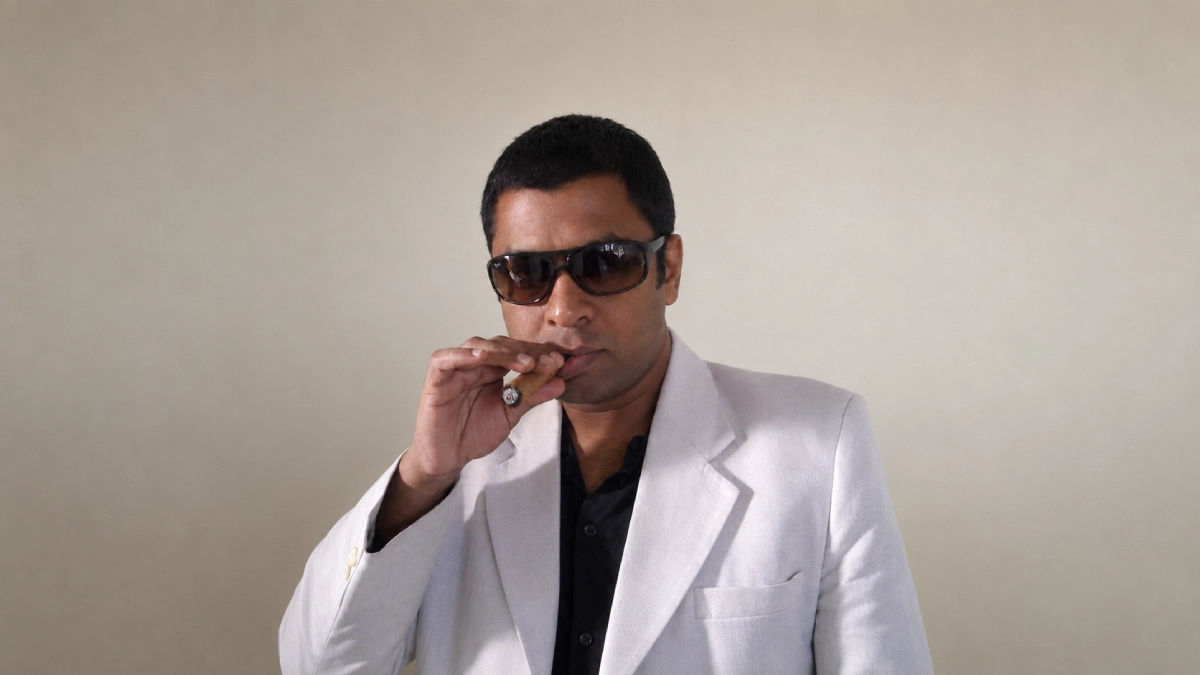
Many of you have asked me why I am named Jamshed Velayuda Rajan.
Well, here is the full story.
My father was born in 1947 in a small village called ‘Maangudi,’ which meant a dwelling place for deer. Back then, it had around 15 houses, and today it probably has 60 of them.
Parthibanur is the closest small town, with a current population of about 12,000. Back in my father’s days, for the villagers, there was no life beyond Parthibanur. If someone crossed Parthibanur, people didn’t say, “He has gone to the next town.” They said, “May his soul rest in peace.”
By profession, my ancestors have been shepherds. We didn’t have a family tree….more like we had a family herd. We were like Santiago in Paulo Coelho’s novel The Alchemist…but we were just better flirts and better husband material.
When my father entered PUC, which back then was equivalent to 12th standard, his father, that’s my grandpa, told him: “You clear PUC, I will let you study. If you fail, you help me with the 200 goats we have.”
Unfortunately, my father failed his PUC, and on the day the results were announced, he borrowed Rs 10 from his sister and ran away from the house. Going forward, I will use ‘logged out’ because ‘ran away’ sounds like a cowardly act.
Also, “logged out” sounds like he had WiFi. Which makes our family history feel slightly more advanced.
Whatever we call it, I thought that was a stupid decision by my father. Let me explain with some math.
My dad ran away from his house in 1965, when his father had 200 goats. Let’s assume 100 of those goats were male and 100 were female – it’s a safe assumption because goats don’t have ‘brains’, so they don’t indulge in female infanticide, and there won’t be gender inequality.
Basically, goats are more socially progressive than many Indian families.
Now it’s also safe to assume that some of these male goats will know how to give their ear to the constant bleating of the female goats. Then there will be some male goats that will not just listen but also bleat back. These were the goats who listened, nodded, remembered anniversaries, and didn’t immediately offer solutions.
Now these “female-friendly male goats” will get laid often, and then there will be baby goats.
Since the lady goats in my grandfather’s ownership won’t be career-focused or need the help of their immediate family to bring up the baby goats, they won’t mind getting pregnant again next year.
Let’s intensify our math now.
– In 1965, my dad had 200 goats.
– 50% of these were female goats, which means 100 of them. Out of these, only half were full-grown lady goats, so only 50 of them could get pregnant. This means 50 new baby goats were born every year.
– Since the average lifespan of a goat is around 10 years, let’s assume out of the 200 goats he had 20 of the goats died every year.
– That’s a growth of 30 new goats in the first year.
– Every year, the net yearly growth would have been 15%.
This means, if this business had continued from 200 goats in 1965…we would have had 1,008,320 goats in 2026.
In case you didn’t know, depending on its breed and weight, a goat could easily cost Rs 5,000 to Rs 50,000. And even if we take a conservative price of Rs 15,000…my 1,008,320 goats, and I say ‘my’ because I would have inherited them, would be worth Rs 1,512 crores.
Now you may wonder…is that even rich? Just so you know, this figure puts me right in between Akshay Kumar, with a net worth of Rs 1,500 crores, and Amitabh Bachchan, with a net worth of Rs 1,600 crores.
Now, if my father was good with math, like me, he would have stayed on, worked with the goats and increased the count. But no…he logged out!
After giving up all this wealth, my dad reached Madurai – the Rs 10 helped him.
As he was roaming around Madurai, he saw a long queue. They were selecting able-bodied men for the Army…and he also stood in the line. I doubt it was patriotism. He probably only wanted food on a regular basis, and some dignity while earning that food. He joined the Indian Army in 1965.
In those days, careers were simple. You saw a queue, stood in it, and by evening your life had changed.
Since he was mildly smart (if he was really smart, he would have stayed on with the goats) they took him into the Electrical and Mechanical Engineers Corps of the Indian Army.
Years later, in 1972, he would marry my mother, and three years later, in 1975, I would be born.
This presented them with a new problem, and I say “new” confidently because this was a couple picked up from the hinterlands of Tamil Nadu and transplanted to 14 Field Regiment, Jamshedpur, Bihar…so they were bound to already have a lot of problems.
After Bihar split into two, Jamshedpur is in Jharkhand.
At this stage, it’s important to know that the city of Jamshedpur was built by industrialist Jamsetji Tata, who wanted to establish India’s first large-scale iron and steel plant. He was the city’s hero.
– -X- -X- –
As my mom lay in bed next to me, and my father stood over the bed looking affectionately at me sleeping, this is how I think the conversation must have gone:
“So what are we going to name him?” my mother asks, still tired after the natural birth of her first child.
“I am thinking something unique,” my father replies.
Naming a child is the second most important contribution a man can make for his baby. The first contribution, of course, is already over nine months before but we men don’t like to discuss it.
“Shall we name him ‘Velayuda’ after Lord Murugan?” my mother asks.
“Sure, that can be his ‘Hindu’ name,” my dad responds with a smile on his face. It’s the smile of a confident man, sure that he is onto something unique.
“What do you mean?” a confused mother asks.
“I think his name must have all three religions in it.”
If my father was alive today, he would have led the HR’s inclusivity team of a massive corporate.
But I am guessing he was driven by what he was seeing around him. The early 1970s were a tough time for seculars. It isn’t a great time now as well, but that discussion is for later. In 1970, the Bhiwandi and Jalgaon communal riots had taken the lives of 250 people, and in 1972, around 20 people had lost their lives in similar riots in Uttar Pradesh.
Maybe joining the Army, or what was happening around him, made my dad a patriotic person…we will never know. But it looks like he wanted to send a message through me.
As I lay there sleeping, I had no clue that I was going to be a messenger – maybe like that ancient Greek messenger Pheidippides, who ran 25 miles from the battlefield of Marathon to Athens to pass on a message.
Or perhaps more like Jesus…because he was both the son of God and his messenger.
But it didn’t seem fair – other babies were busy passing gas while I was was carrying the burden of national integration.
Either way, the conversation between my parents continued.
“Jamshed can be his Muslim name, and with luck, he may even grow up to be as great as Jamsetji himself,” my father continued.
Back then, my parents didn’t know that Jamshed was a Parsi name.
“And what will be the third religion in his name?” my innocent mother asked.
“Christianity, of course. But I am worried because the only Christian names I know are Robert, Peter, Michael, etc., but Bollywood always names the villain’s henchmen with these names.”
My father was a major Bollywood fan, so he knew what he was talking about.
So, on the day of my birth, they were able to finalize my two names, but for the third name, they had to take the help of their Malayali neighbour. Yes, Malayalis are everywhere! If Neil Armstrong had looked carefully on the moon, he would have found one Malayali running a tea shop behind a crater.
The Malayali lady suggested “Rajan,” saying it was a Christian name…and my parents bought it.
Rajan is not a Christian name…the Malayalis were wrong. On an unrelated topic, I have in my house a Malayali – my wife – who is always right!
But the name stuck, and I was named Jamshed Velayuda Rajan. Thank God my dad didn’t want to integrate Sikhism as well for then it would have been Jamshed Velayuda Rajan Singh.
You probably wonder why I don’t have my surname behind my name. That’s because only two states in India – Tamil Nadu and Mizoram – are notable for not using surnames.
It is a cultural shift popularized in the 1920s to eradicate caste-based identities. Without a surname, we can’t immediately identify the caste and start our discrimination.
Now we have to be a little open about it. We ask, “So what caste are you people?” and then discriminate.
Most Tamilians use their father’s name as their surname. I don’t do that as well because, if I did, my name would be too long – Jamshed Velayuda Rajan Ramaswamy. And by the time someone finished calling my full name, I would have had two more goats!