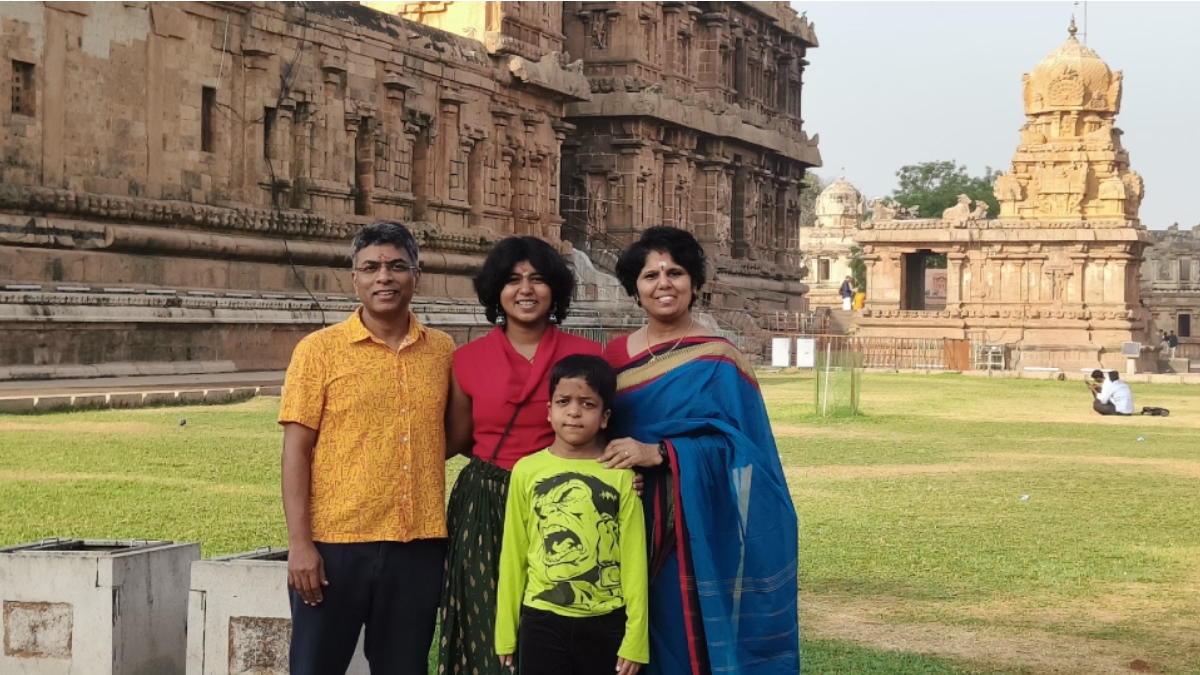
Before we got married in 2004, Rekha and I lived-in for 18 months. I can post this confidently today because, unfortunately, Rekha’s dad is no more to twist my arm, and her mom is not on Facebook.
I was telling this to a Bangalore friend of mine, and she said, “Really? Isn’t Chennai conservative?”
I said, “No, ma’am. It is anything but conservative.”
She didn’t believe me.
Then I had to show off Kanchipuram’s achievement as the “cheating capital” of India. In case you don’t know, for the last two years, residents of the small city, 60 km from Chennai, have downloaded the Ashley Madison extramarital dating app more times than those of any other city.
“We may act conservative, but deep down, we are all beasts,” I said, finishing my marketing campaign for Chennai.
Now, coming back to living together—as Charles Dickens wrote in his 1859 novel ‘A Tale of Two Cities’, it was the best of times, it was the worst of times.
I don’t remember who first broached the topic of living together, but I definitely benefited.
You may hear “live-in relationship” and imagine two young people enjoying freedom, romance and unlimited physical intimacy.
Ours was more like an eighteen-month-long undercover operation in which one wrong move could result in Rekha’s father twisting my arm, her mother crying and my parents disowning me.
You must remember that this happened more than twenty-three years ago. Today, if an unmarried couple lives together, one of two things may happen – the custodians of religion(s) may take offence and separate the couple to safeguard the religion, or the neighbours may get busy watching Instagram reels and forget to inform the “keepers of Indian culture.”
Back then, in Chennai, an unmarried couple renting a house together was treated as if two terrorists had quietly moved into the neighbourhood.
So, from the moment we started looking for a house, Rekha and I had to behave as if we were already married.
I don’t remember if we had invented an anniversary date, but if somebody had asked us when we got married, we would probably have given two different timelines. In fact, this is one blunder that can happen even today – Rekha would correctly say, “8 September 2004,” while, under performance pressure, I might end up giving some other date.
After we lied a bit and convinced our landlord, we had to plan our housewarming ceremony carefully.
So, we brought in the most powerful weapon available to a young Indian couple who wanted to live together – someone else’s mother.
My friend Dennis’s mother agreed to step in and conduct the housewarming ceremony for us. The moment she entered the house, lit the lamp, boiled the milk and blessed us, our relationship became respectable.
Nobody asked whose mother she was. Everybody probably thought she was my mother.
The gratitude isn’t lost on me – I still call her once every 15 days and tell her what’s happening in my family.
But after the housewarming was over, we realised that Rekha didn’t look married. The visible indicators of marriage that a woman has to wear to announce to the world that she is taken and not available weren’t there.
I don’t know why society needs so many symbols to prove that a woman is married. A man can roam around looking exactly as irresponsible as he did before marriage, but a woman has to wear a mangalsutra, toe rings, bangles and the name of the duffer she married.
That’s why, for the first few days, she had to wear a metti – the toe rings married women wear in Tamil Nadu – just in case somebody decided to look at her feet. Then she figured it was much easier to wear sneakers while stepping out of the house.
“What if somebody asks where your mangalsutra is?” I asked on day two.
“We will say I am a Christian, and that’s why I only wear a ring. What say?”
“Yes, I think it should work.”
In those days, we didn’t have to worry about neighbours with CCTV cameras. Instead, we worried about people who had balconies, plastic chairs and unlimited time.
I still remember the house we had rented in an upcoming area called Velachery – we owned almost nothing.
We had two mats to sleep on, one pan to make tea, one kadai in which we could make only one dal at a time, one tawa for rotis and one pressure cooker.
The menu depended not on what we wanted to eat but on which vessel was currently available. What made it even more interesting was that Rekha had been living in hostels since first year of college and didn’t know how to cook.
We didn’t have a bed, a sofa, a television, a refrigerator or a dining table. We cooked in the bare-bones kitchen, ate sitting on the floor and slept on the floor.
I think this austerity kept us together…getting angry and walking out dramatically during a fight was difficult because we first had to get up from the floor.
The first big possession we bought together was a table fan.
Back then, it must have cost us less than ₹800, and to save some money, we went to T. Nagar, which was 10 km from our home.
Once we had bought the table fan, we realised that buying it was easier than bringing it home. Rekha sat on the pillion holding the fan for almost thirty minutes as I navigated Chennai traffic on my Yamaha.
Whenever I braked, Rekha and the fan came forward, and whenever I accelerated, they both went backwards. It was a difficult ride home.
But everything was forgotten once we reached home safely, plugged in the fan and sat in front of it – the breeze seemed heavenly.
That fan was our first major possession, and after 23 years, we still have it.
During that time, we used to buy all our groceries from a small shop about 50 metres from our house. The owner was the most inquisitive man I had ever met.
“What work do you do?”
“Where is your office?”
“How long have you been married?”
“Where is your wife from?”
Within two visits, he knew more about me than my company’s HR department.
During the first two or three months, Rekha alternated between our house and her PG accommodation in Mylapore.
The grocery-store owner noticed this.
One evening, while weighing half a kilo of tomatoes, he casually asked, “Why doesn’t your wife leave for the office with you every day?”
For a moment, I froze, but then I remembered that I was a Rajan.
And two things about Rajans are true – they don’t let down their women (notice the plural!), and they are born storytellers.
Over the next two minutes, I created a career for Rekha so impressive that even she would have been surprised. I told him that my wife was an MBA, far more educated than I was, worked for a much better company and was in sales, which required her to fly to Delhi, Mumbai or Bangalore at least once every week.
Whenever she travelled, I explained, I stayed behind in Chennai, took care of the house, cooked my own meals and somehow carried on despite the enormous difficulties.
That day, I learnt that everybody loves an underdog, for he stopped looking at me suspiciously and started looking at me with sympathy.
After a few months she started spending more and more time at our house. But we continued paying the rent for her PG because our undercover operation required a safe house for an emergency.
And that emergency did come one morning when her Nokia 3310 rang at 6 a.m.
Rekha’s parents had arrived in Chennai, and after getting down at the railway station, they were on their way to her PG.
They wanted to have breakfast with their daughter, attend a wedding in the family and catch the evening train back to Kannur.
“Rajan! Get up!” Rekha shook me awake.
Whenever your girlfriend wakes you up urgently while you are in a live-in relationship, you don’t ask, “What happened?”
You assume the worst has happened and go from snooze mode to commando alert in two seconds.
“My parents are coming to the PG.”
My sleep left my body so quickly that I think it remained on the mat after I stood up.
“Where are they now?”
“They have left the Central railway station.”
“How much time do we have?”
“I don’t know.”
In 2003, we didn’t have live locations, so we had to estimate their location using possible traffic, actual distance, lots of prayer and a bit of fear.
Rekha rushed to get ready while I started walking around the house without knowing what to do.
“Remove the metti!” I said.
“I removed it a long time ago,” she shouted back.
“Anything else?” she continued.
“I don’t know. Look like an unmarried girl!”
Within minutes, we were on the motorcycle, racing towards the PG.
It felt as if the whole world was conspiring against us – every red light we stopped at seemed to be teasing us, and every slow-moving bus in front of us appeared to have been sent by Rekha’s father.
At one signal, Rekha asked, “Can’t you go faster?”
“If I go any faster, your parents will have to visit us in the hospital instead of the PG.”
We finally reached the street. I dropped her a little away from the PG, rode to a safe distance and waited…like a getaway driver waiting after dropping his pals at the entrance of a bank.
Rekha walked inside, and within a few minutes, her parents reached the hostel gates in an autorickshaw.
Then Rekha casually walked out of the PG to receive them, as if she had spent the night there and had definitely not been sleeping beside a criminal on a mat.
Her parents returned without discovering anything, but the next time they came to Chennai, Rekha would break the news to them.
But that story is for later.
For eighteen months, Rekha and I lived like that – half terrified, half excited, extremely poor but completely happy.
We had no furniture, very few vessels and no idea what we were doing. But every morning, I made tea in that one pan, and every night, we rolled out our two mats next to each other.
Today, our house is full of things. We have beds, sofas, televisions, multiple pans, multiple kadais, multiple tea strainers and enough possessions to last us a lifetime.
But I still remember that almost-empty house. I remember Rekha sitting behind me and holding our first purchase – the table fan – as we travelled through Chennai traffic.
I remember Dennis’s mother stepping in for us in a brown saree so that the neighbourhood would believe us.
And I remember racing to the PG because Rekha’s parents were approaching, and our entire future depended on her walking out of that gate at the right time.
We told many lies during those eighteen months, and the biggest lie was that we were already husband and wife.
Twenty-three years later, that is the only lie that became the truth. I guess some lies are like that – you repeat them long enough, and they come true.