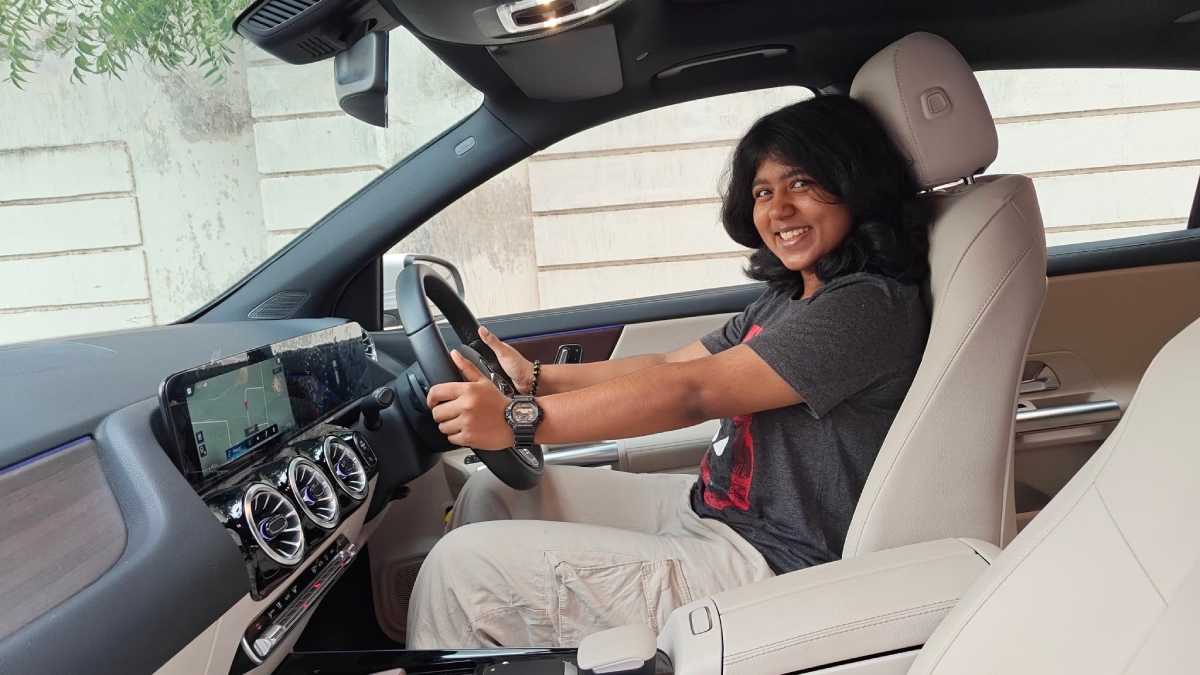
Today let me tell you how Rekha helps me drive the car safely.
The moment the whole family gets into the car – or, to be more accurate, while the whole family is still in the process of getting into the car – Rekha will say, “Rajan…lock it.”
I will look at her and say, “At least let Ritwik get inside and close the door first.”
Ritwik usually gets in slowly and settles down, while I put on my seat belt, and check the mirrors.
Before I can even start the car, Rekha will ask again, “Did you lock it?”
I will say, “Don’t worry, Rekha. The moment the car goes above ten kilometres per hour, the doors lock automatically.”
This explanation does convince her, but gives her one more responsibility – to stare at the speedometer and wait for it to cross ten kilometres. The moment it does, she will turn towards me and ask, “Did it?”
I will give her a look and say, “Didn’t you hear the click?”
She will say, “I heard the click. But what if it only clicked and didn’t lock?”
This is why I think the car manufacturers must introduce a new feature – as soon as the doors are locked, the speaker should announce it, “Doors of this car are now locked! You may now relax.”
You have known us Rajans for a while now and know that we are patient. Any more patient, and we would have been admitted in a hospital. So I patiently assure her that, yes, the doors are locked.
“Even the two doors at the back?” she will ask.
By now, I will be on the verge of losing whatever little peace I had when I woke up that morning, but I will clench my teeth, breathe slowly and say, “Yes, Rekha. The back doors are also locked.”
My friends and colleagues often ask me how I manage to remain so calm, why I rarely lose my temper and how I have developed such tremendous patience. They don’t know that Rekha makes sure I practice every single day.
Once the locking ceremony has been completed and certified by all authorities concerned, I will start driving. After a few minutes, I will glance towards Rekha and notice that her left hand is gripping the side rail on the passenger door with all the strength available in her body.
She holds it as if the car is not travelling on a normal city road but is hanging from the side of a mountain, and if she loosens her grip even slightly, the entire vehicle, the passengers, and 100 members of her side of the family will fall into the valley.
I have tried explaining to her that the passenger side of the car has three airbags: a dual-stage front airbag in the dashboard, a side thorax-pelvis airbag in the seat, and a side-curtain airbag covering the passenger window area. God forbid we are involved in an accident, these airbags are designed to activate and protect her, which means she does not need to hold the railing of the door as though she is single-handedly preventing the car from breaking apart.
But will she listen? Of course not – she is a lady out to protect her family.
So, from the corner of my eye, I will watch her hand slowly turning pale because of the pressure of her grip. But I will remain silent because, after several years of marriage, a man learns that not every observation needs to become a conversation.
Having said that, you must remember that we are Rajans and we don’t let a family member down. So, after some time, I will say, “Rekha, if your left hand is hurting, there is another grip near the bottom of your seat on the right side. You can hold that instead.”
She will smile, release her left hand and immediately grip the other handle with her right hand.
She is happy that because of her the car remains safe.
Now, an average car contains somewhere between thirty thousand and forty thousand individual parts, including the engine, transmission, body, suspension, braking system, sensors, electronics and several computers that are constantly checking whether everything is functioning correctly.
In addition to all this advanced machinery, my particular car also has, behind the steering wheel, a fifty-year-old man who has been driving for decades, and has reasonably good eyesight.
Yet Rekha firmly believes that the car reaches its destination safely only because, once every five minutes, she says, “Paathu po, Rajan.”
In English, this roughly translates to, “Go carefully, Rajan.”
But the English translation does not fully capture the meaning.
Depending on her tone, it can also mean, “You are going too fast,” “There is a vehicle close to us on the left,” “I don’t trust that man on the motorcycle,” “There may be a speed breaker within the next five kilometres,” or simply, “I have not given you a driving instruction for several minutes and I am beginning to feel irresponsible.”
And so, every few minutes, regardless of whether I am driving at eighty kilometres per hour on the highway or crawling at eight kilometres per hour behind an auto-rickshaw, she will say, “Paathu po, Rajan.”
I will say, “I am going carefully.” I emphasis on ‘am’.
She will reply, “I am only telling you.” She will emphasis on ‘only’.
There is no answer to this.
Then, every ten minutes, she will turn around and check on the children.
“Rhea, are you okay?”
“Ritwik, are you okay?”
And it is not as though, if something were suddenly wrong, like Jackie Chan she would squeeze between the driver’s and passenger seat in the front to the back seat and personally resolve the emergency.
A few months ago, while we were driving to Pondicherry, Rekha turned around and asked Ritwik, “Are you okay in the back seat?”
Ritwik replied, “Amma…I feel like puking.”
Now, I had heard Ritwik. He was sitting barely three feet behind me. But Rekha didn’t give me any chance to react.
She Rekha looked at me with urgency and said, “Rajan…Ritwik feels like puking. Do something!”
I pulled the car over to the side of the road, found a reasonably safe place to stop, switched on the hazard lights, got out, walked around the car, opened Ritwik’s door, helped him out and guided him towards a patch of grass, where he vomited his heart out.
All this time, Rekha remained seated inside the car, holding the side rail on the passenger door and making sure the situation did not go out of control.
To her credit, once Ritwik finished, she handed me a bottle of water through the window, which I then gave him so that he could rinse his mouth.
While I was still standing on the roadside, one hand holding Ritwik, the other hand holding the water bottle, and keep an eye on speeding buses, Rekha lowered the window by approximately three inches and asked for a status report, “Rajan, is everything okay?”
I said, “Yes, Rekha. Everything is under control. Thank you!”
But she did not appreciate the sarcasm.
We got back into the car, I checked the mirrors, put on the indicator, waited for a safe gap in the traffic, and slowly merged back onto the road.
The car had barely moved twenty metres when Rekha asked, “Did you lock the doors?”
I looked at her. She looked at me.
There are certain moments in marriage when words become unnecessary, because twenty years of living together allows two people to communicate through the eyes. But this was not such a moment, so I replied patiently, “Yes, Rekha. The doors are locked.”
“Even Ritwik’s door? Because you opened it just now.”
“Yes, Rekha. Even Ritwik’s door.”
After five minutes, Rekha said, “Drive slowly.”
At that moment I was driving at forty-eight and the speed limit was eighty. And a weekend cyclist had just overtaken us.
I said, “Rekha, I am already driving slowly.”
She said, “Not now. I am telling you in advance.”
This is one of Rekha’s special abilities. She can issue warnings for mistakes I have not yet made, thereby saving time later. Most wives will wait for something to happen before blaming their husbands, but Rekha is a better wife – she blames him/corrects him even before it happens.
Over the years, I have realised that there are three navigation systems inside our car: Google Maps, the road signs, and Rekha.
Of these, only one has no access to satellites, traffic data or updated maps, but it speaks with such confidence that the other two begin to look unreliable.
Then there is the question of braking.
Whenever a vehicle in front of us slows down, Rekha presses an imaginary brake with her right foot. Sometimes she presses it so hard that her entire body moves forward and she produces a small sound like “Aiyyo!”
I once told her, “Rekha, there is no brake on your side.”
She said, “I know.”
“Then why are you pressing your foot?”
“I am helping you.”
Even though my kids sit through all of this peacefully, once in a while they come to my rescue.
Rhea will say, “Amma, Appa knows how to drive.”
Rekha will reply, “I know he knows how to drive. That is why I am telling him to drive carefully.”
Rekha also helps me find parking spots. I don’t want her to help me with parking, but she does. At this point it is important to note that she doesn’t know how to drive.
“There is space there,” she will say, pointing at a narrow space in between two cars.
I will say, “The car won’t fit there.”
“It will fit. You don’t know until you try.”
I so want to tell Rekha that I love her positive attitude that everything is possible, but in this case parking a car in that space won’t be possible. But that would be like insulting a woman for taking initiative so I remain silent.
I find another parking spot and begin reversing into it.
Immediately she will turn around, look through the rear window and say, “Come, come, come…slowly…come…come…STOP!”
“Thank you Rekha,” I will say but continue relying on the reversing camera, parking sensors, rear view mirrors and my own 25 years of driving experience for parking my car.
Finally, I will switch off the engine, and sit silently for a few seconds, enjoying the unfamiliar sensation of the car not moving.
Rekha will release her grip on the side rail, inspect the position of the car through the window and say, “You could have parked a little more to the left.”
I will smile because that’s the only thing I can do. Besides, smiling uses up fewer calories than arguing, and I need to conserve my energy for the return journey.
Then she will open the door, step out, and before walking away she will turn back and ask, “Did you lock the car?”
I will press the remote. The car will make a loud locking sound and flash its lights.
She will wait for a second and ask, “Did it?”
And I will say, “Yes, Rekha. It locked.”
The best part is, as we are walking towards the hotel, Rekha will look at Rhea and say, “You know Rhea, appa couldn’t even park properly…I had to crane my neck back and guide him.”
Rhea knows, but she is also a Rajan…so knows when to speak up and when to remain silent. So she smiles at her mother, but winks at me. I wink back. All is well in the Rajans family.