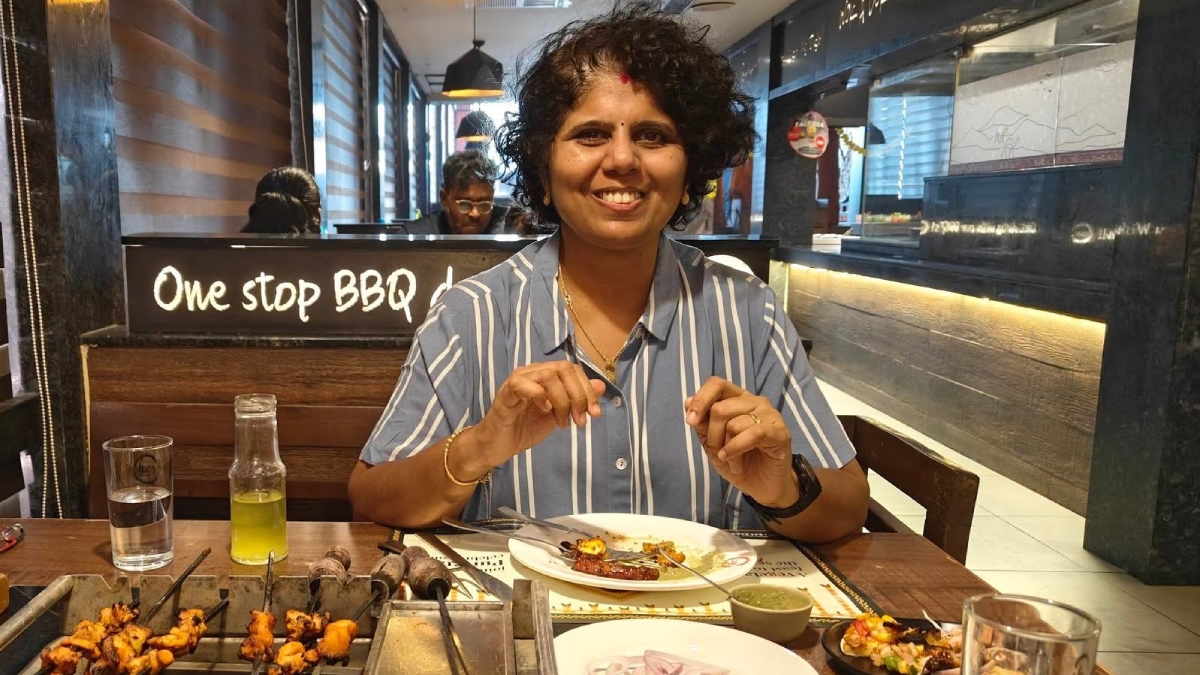
It is nice to know that strangers on the internet are worried about my wife’s mental health, while my wife is worried about my travel start-up, my cholesterol, my driving, my eating habits, whether I locked the door, and why I am breathing like that.
And yes, she did go once.
To understand why she stopped after one session, you need to understand Rekha.
Unfortunately, to understand Rekha, you also need to understand me.
Rekha has always been anxious. Maybe she was born that way.
Or maybe I upgraded her to the “anxious” state.
When we were dating, especially on lonely roads at night, I would switch off the engine of my Yamaha RX135 and say, “Oops… I forgot to fill petrol.”
The bike would slowly roll to a stop.
Then I would get down and start kicking the bike dramatically. Rekha would stand beside me on the empty road, getting more and more irritated.
“Rajan, how can you be so careless?”
I would continue kicking.
“Rajan, this is not funny.”
I would still continue kicking.
After torturing her for a few minutes, I would smile, say “Ta-da!”, switch on the ignition, and start the bike.
I could see a sense of relief in her, and a surge of love at the same time. Of course, she would hit me a few times before getting back on the bike.
At that time, I thought she was impressed by my sense of humour.
Now I realise I was slowly converting a perfectly normal woman into a disaster management department.
But here is the thing about Rekha.
She is not weak. She is a very strong, fiercely independent woman. She is also a competitor.
Not a normal competitor. The kind who can even turn drinking water into a competition.
If I tell her that I have drunk five glasses of water so far, she will drink six and let me know.
I like that about her. I think I got it from my father. He also loved my mother’s strength. In our house, the men have always admired strong women.
Maybe because we had no other option – weaker men need strong women around.
A few months after we got married, Rekha got promoted and was offered a chance to work on a long-term project in the US. She refused because she knew I would struggle to find a job there.
Two years later, Rhea was born. Rekha decided to take a break from work because she wanted to lay a strong foundation for the child.
Then she went back to work for a few years. Then Ritwik arrived. Again, there was a break.
So when she finally returned to full-time work in her early 40s, something happened inside her.
She looked around and felt she had been left behind.
In her mind, everyone else had been running a marathon. At the same time, she had stopped to feed children, pack tiffin boxes, check homework, attend PTMs, buy socks, find missing water bottles, read to them extensively, and remind her husband to behave like an adult.
So she decided to catch up.
But Rekha being Rekha, didn’t decide to jog slowly. She decided to run a marathon at the speed of a 100-metre race.
And for a long time, she succeeded. Then it started taking a toll. She couldn’t sleep at night. She would wake up in fear.
We made a few late-night hospital visits to the emergency department because she thought something terrible was going to happen to her.
This is where people say, “Please see a doctor.” And she did.
The doctor listened to her and said, “Ma’am, from what you say…I can see you are very competitive. I understand what you are going through. Why don’t you meet a psychologist?”
Two days later, we fixed an appointment. I had work, so she went alone.
As she sat in the psychologist’s reception, she looked around at the other patients and started wondering what kind of problems they had.
This is Rekha. Even in a clinic, she is doing market research.
Then she saw a board. It said the doctor had improved more than 100,000 lives.
She immediately Whatsapped me.
“Rajan, this doctor has seen more than one lakh patients.”
I replied, “Wow. That’s damn cool. He must be good.”
She replied, “Yes. And I have decided to be the best patient he has ever had.”
I had to call her immediately.
“Rekha, being a patient is not a competition.”
There was silence.
Then she used her usual, “You won’t understand.” And I knew I didn’t understand this bit.
Anyway, she attended the session. After that, she came to one conclusion. Nobody can help her. Only she can help herself.
I don’t fully agree with her. I still think help is good. Therapy is good. Doctors are good. Sometimes, even husbands are useful, though evidence is limited.
But I also know Rekha. She has spent most of her life holding things together. Her career. The kids. The house. Me. Especially me.
And now, when anxiety knocks on the door, she doesn’t open it and say, “Please come in.”
She says, “Wait. First, tell me why you have come, how long you will stay, and whether you have brought your own charger.”
So yes, Rekha has anxiety. She has seen a professional – once. And yes, she may need to go again.
But knowing Rekha, if she ever goes back to therapy, I have to visit the clinic first and ensure there are no competitive triggers.
Because my wife doesn’t read the “100,000 lives improved” board as a credential. She reads it like a leaderboard.