When a Parliament controversy broke out over the word ‘lungiwala,’ I realised one thing: India still has not understood the lungi properly.
I am not offended because someone mentioned the lungi…I am offended because they used one of mankind’s most comfortable inventions as an insult.
If you don’t follow Indian news, here is what happened: In Parliament, Member of Parliament Mr John Brittas alleged that BJP MP Sushmita Dev called him “lungiwala,” while she has gone on record denying it. Mr Brittas is upset that the word was used as a derogatory term to refer to all South Indians who wear lungis.
I don’t know what really happened because I wasn’t there, but I thought it was the right time to talk about my favourite attire – the lungi.
But as a South Indian man who has spent enough time around lungis, mundus, panchas, veshtis, and other pieces of cloth that have held the four Southern states together, I must assert that “lungiwala” was indeed a bad reference.
Not because lungi is bad, but because of the “wala” that got attached to it.
In India, the moment we add “wala” to something, it becomes slightly suspicious.
“Chaiwala,” “Dabbawala” and all are OK, but when you say “lungiwala” in a mocking tone, it sounds like you are making a judgement.
I may be speaking for all South Indians here, and it is possible that I am wrong…but we don’t like being judged by people whose nightwear has elastic.
But let’s not be too harsh on Sushmita Dev. We must forgive her because she probably does not know enough about lungis…after all, she is a pyjama-wala.
And pyjama-walas cannot fully understand lungi-walas. It is not her fault.
—-X—-X—-
People who have not grown up around lungis don’t understand the power of the lungi.
They think it is just cloth. They don’t know that it’s the only attire that comes with air-conditioning and storage attached.
It is also the only garment in India that has two modes – the ‘respectable mode’ and the ‘action mode’. The best part is that you can go from one mode to the other in less than three seconds.
When you wear it full-length, in respectable mode, you are a decent family man. But the moment you lift it and tie it around your waist, in action mode, you become the wild child, with AR Rahman’s music playing in the background.
I am sorry, Ms Sushmita Dev, no pyjama can do this.
I would even go to the extent of saying that the lungi is the Karl Marx of the textile industry. After all, the best part about the lungi is that one size fits all. Now, isn’t that socialism in cloth form?
Maybe that’s why mastering this is not easy. I remember a North Indian friend of mine saying, “How hard can it be…just wrap it around your waist.”
Poor guy, little did he know that to wear a lungi properly, you need hand-eye coordination, wrist strength, and the confidence that a 16-year-old Sachin Tendulkar had when he played his career’s first match against Pakistan in Karachi.
There is also another great advantage, which nobody told Ms Sushmita Dev – that when you wear a lungi, wearing something on the top half of your body is optional.
Can you name any other dress that gives you this privilege?
In South India, when a man wearing a lungi is bare-chested, he is not underdressed. He can stand in the balcony, read the newspaper, drink tea, chat with the milkman, or water plants without being ashamed of himself.
While all other garments need a pocket to store things, a lungi by its very nature is a useful storage device.
You can lift and tie a lungi and keep things inside. From experience I can confirm that it is ideal for money, keys, handkerchiefs, mobile phones, 250 grams of onions, Lay’s chips packets, one The Hindu newspaper, etc. Just don’t keep coins…not because the lungi can’t handle them, but because then everyone will know your financial condition.
The truth is, every region of India has its own clothing pride.
I thought Ms Sushmita Dev should know because she is well travelled. Oh wait, my bad…she has only travelled from the Indian National Congress to the Trinamool Congress in 2021 and then to the Bharatiya Janata Party in 2026.
She probably doesn’t know that in India, some wear pyjamas, some dhotis, some mundus, some veshtis, and some lungis. And that’s what I love about India…we don’t have one dress code, we are the whole wardrobe.
—-X—-X—-
If you have been a regular reader, you know that Rajans are honest people. We lie, but only to women we want to impress.
Otherwise, we are usually straightforward.
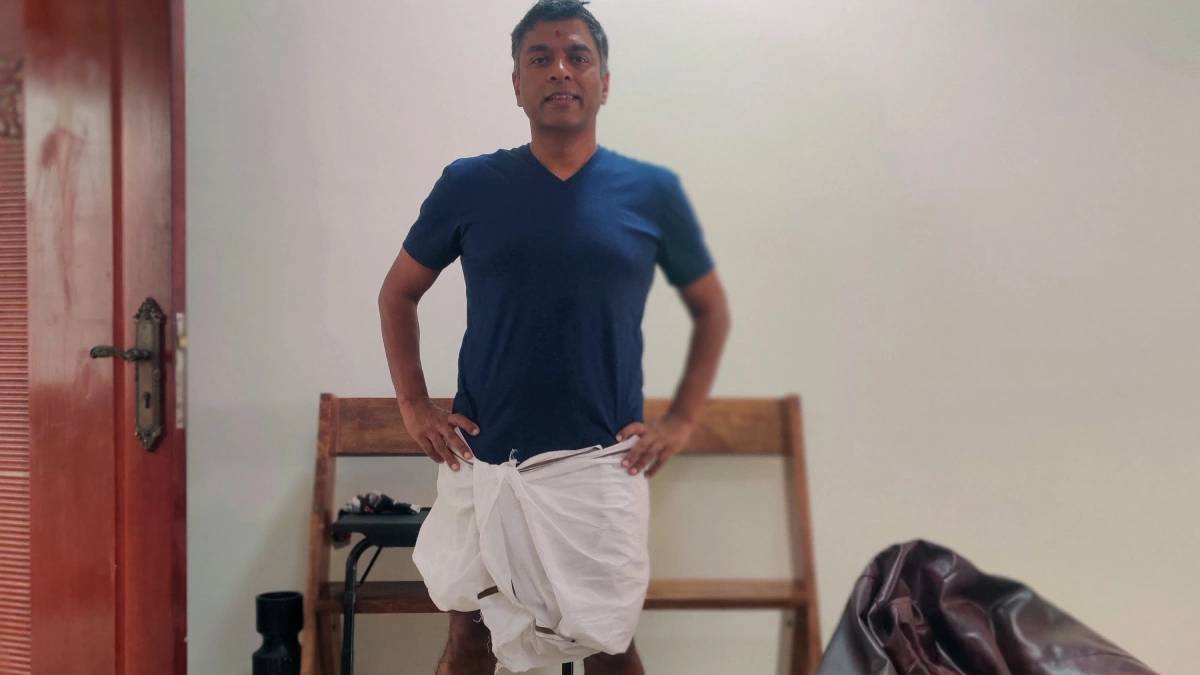
Today, I am angry at the ‘lungiwala’ comment because in the last five years, I have become a lungiwala myself.
When I lived in North India, I wore shorts at home…they were casual, modern and effective.
When we moved back to Chennai in 2021 to save money because my startup wasn’t doing well, I started wearing something dignified at home…a veshti.
A veshti is slightly different…it is, let’s say, an elder brother of the lungi. At first, I didn’t like it much, but with time, I started loving it.
And over the last five years, I have become an experienced lungiwala. I can walk, run, sit, squat, shout, eat, argue, ride a bike, and chase a dog without exposing what’s inside.
As a result, I have come to love it. And you don’t mess with something a Rajan loves because when you do, you mess with a Rajan.
So next time you feel like saying ‘that lungiwala,’ I urge you to use ‘that gentleman’ instead.
Now that the modest lungi is news, I would like to propose an idea – let’s dedicate a day to this classic attire and call it “Lungi Appreciation Day.” I propose 26 April because that’s my birthday.
On this day, it must be mandatory for all MPs to come to Parliament in lungis, mundus, veshtis, dhotis, or whatever their region proudly wears. Because when all of us do that, we will realize the truth…that all the power in our hands is temporary and that only the knot that keeps it together matters.