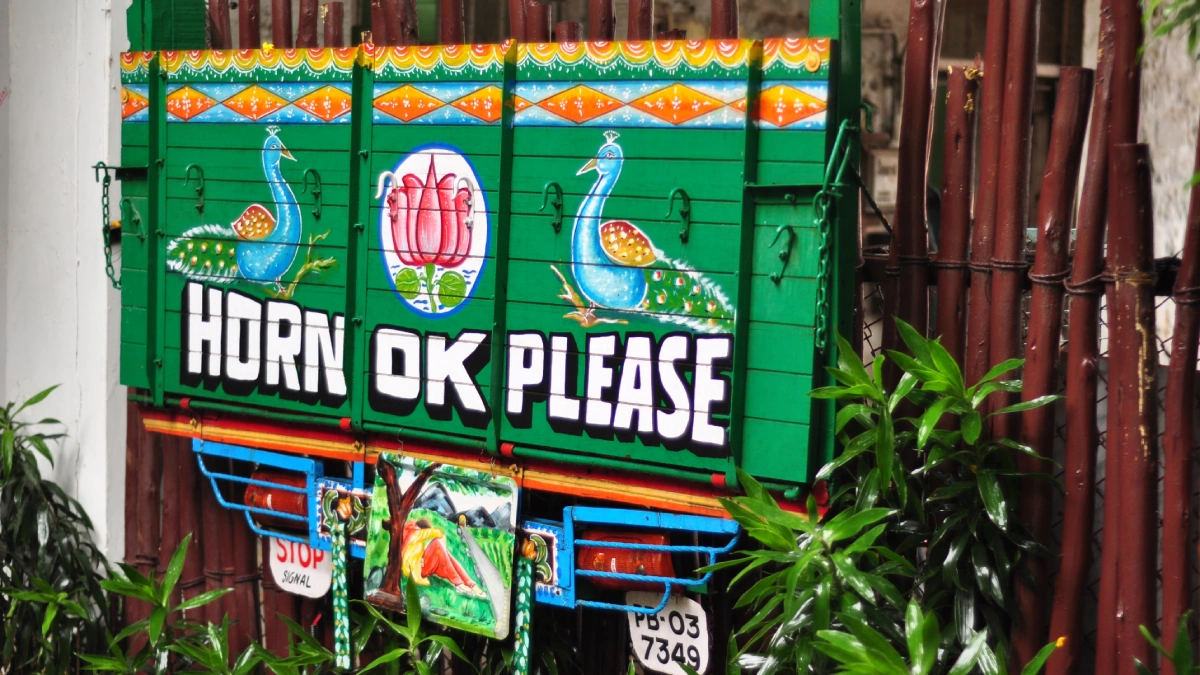
There has always been a huge communication problem between men and women in India.
This is not new. This has existed from the time the first man came home late and said, “crazy traffic.”
But this communication problem becomes even more serious when the man and woman involved own trucks.
You may think truck ownership has nothing to do with marital communication. In Jammy’s world everything has something to do with marriage. Even the back of a truck.
Usually, in a marriage, women don’t feel the need to stop talking, and men don’t feel the need to start talking.
That is the basic problem. While a woman will want to discuss the issue, a man will think it will dissolve naturally, like Eno in water.
But over the last fifty years or so, this inability to communicate has taken a totally different dimension. Let me not keep the suspense any longer.
Yesterday, by a combination of charm, foolishness, and standing near the right tea shop at the right time, I broke into the trusted inner circle of women truck owners.
They are a very powerful group, and only mentally strong people like the Rajans can enter. They don’t allow ordinary men inside.
And there, over tea strong enough to wake up a dead man, I was told a fifty-year-old secret.
Men and women who owned trucks have not been fighting openly all these years. They have been communicating with each other through messages painted on the back of their trucks.
What we thought were traffic instructions were actually marital messages. What we thought was road safety was actually husband and wife trying to discuss what they couldn’t discuss in person.
I asked the lady truck owner who had let me in on the secret, “How did all this begin?”
She looked around carefully, as if the other not-so-smart-men were listening, and then said, “It started sometime around 1960.”
“1960?” I asked.
“Yes,” she said. “Back then, Indian women were traditional, shy, and not very open about certain matters. And our truck-owning husbands had one major complaint.”
“What complaint?” I asked innocently, because in such situations one must pretend innocence.
She leaned forward and said, “They felt they were not getting enough…attention.”
Now, when a woman pauses before the word attention, you must understand that the matter is not about emotional attention.
It is about married life after the children have slept.
I said, “And then?”
“That is when the Truck Owners Association of Men held a secret meeting.”
“Where?”
“Obviously, near a mechanic shop. Where else will Indian men discuss romance?”
Fair point.
She continued, “The men decided that since they could not directly tell their wives what they wanted, they would write it on the back of their trucks.”
“What did they write?”
She looked at me and said, “Blow Horn.”
I sat silently for a few seconds. I knew exactly what the husbands had been missing. A terrorist can blow a car, but to blow a horn, you need a girlfriend or a wife.
Suddenly my entire childhood changed. All these years, whenever I saw “Blow Horn” written behind a truck, I thought it was a traffic instruction.
I thought the driver was asking the vehicle behind him to honk.
I did not know I was witnessing a coded message from one lonely husband to his wife.
I asked, “But how did that help?”
She said, “Back then, the trucks used to be parked in front of the house. Every morning, the wife would come out, draw kolam, sweep the front yard, look up, and see the message.”
Absolutely brilliant. Indian men may not know how to express feelings, but give them a lorry and two tins of paint, and suddenly they become John Keats.
I asked her, “So how did the women respond?”
She smiled.
“We also had an association,” she said.
“Women Truck Owners Association?”
“Yes. We met quietly and decided to respond appropriately.”
“What did you write?”
“We wrote, ‘Keep Distance.’”
I almost clapped. Women…they are smarter, I thought. But didn’t say.
This is how most Indian marriages function…the husband makes a request, while the wife dismisses it. And yet then both continue living together.
The message spread quickly. Soon, women-owned trucks everywhere started carrying “Keep Distance” behind them.
Apparently the men were shocked. They hadn’t expected the women to revolt.
I asked, “What happened next?”
The lady’s face changed. “The men became obnoxious,” she said.
I stayed silent. When your whole gender is being nailed to the cross it is better not to defend them.
She said, “They responded with a new message.”
“What message?”
“Use Dipper at Night.”
At this point I realised that the truck communication war had become serious.
This was no longer simple husband-wife misunderstanding.
I asked carefully, “Did the women understand what the men meant by ‘Use Dipper at Night’?”
She looked at me as if I had asked whether women understand sarcasm.
“Of course we understood,” she said. “But it made things worse.”
“Worse?”
“Yes. We decided that if men wanted to communicate like this, we would not cooperate for months.”
Now, this is where men always underestimate women.
“What did the men do then?” I asked.
“Nothing,” she said.
“Nothing?”
“Nothing. For six months.”
This is very believable. If there is one thing Indian men are capable of doing during an emotional crisis, it is nothing.
We can sit with the problem, avoid the problem, discuss cricket near the problem, drink tea beside the problem, and still not solve the problem.
So the women waited for a bloody long time. Finally, when they realised the men were not replying, they decided to escalate.
“What did you write?” I asked.
She said, “Horn OK Please.”
I nearly fell off my chair.
All these years, I thought “Horn OK Please” was a message for someone following a truck to honk. But apparently no….it was a question from a wife to her husband.
“Horn OK Please” was the women asking the men, “Your so-called horn…is it okay?”
This was a surgical strike.
I asked, “Did the men get angry?”
She said, “Angry? They came back to us.”
“On all fours?”
“Not exactly all fours,” she said. “But close.”
I believed her.
Every married man has at some point returned not exactly on all fours, but close.
“What did they do as apology?” I asked.
She said, “They painted ‘We Two, Ours Two’ on their trucks.”
So after months of coded romance, protest, counter-protest, the men had finally surrendered.
Their message indirectly said, “Let us stop all this nonsense and raise two lovely children.”
The husbands were back on track, and it didn’t matter to them if the horn was not blown or if the dipper was forgotten. And everybody lived happily ever after.
Hi Jammy, as I was enjoying your blog, I suddenly remembered that on my way to Shillong, I encountered a few such funny behind-the-truck messages myself. Surprisingly most of them would have something holy or spiritual written on them, beginning with “Innocence”, “Amazing Grace”, “Sweet Jesus” or suchlike. Of course I came across another which has nothing to do with spiritual really. It went — LOVE ME MORE…KISS ME…CONTROL…. I guess if we were to look at it from a Gandhian point of view that reflects self-control, this would seem spiritual too!
hahahha lol ……….its really funny…
I must say this is brilliant selection! but I must add one that I’ve heard a lot of buzz about, and having looked at the site
myself must say its very impressive.
to anyone that enjoyed these blogs be sure to check it out.stylehoops
Trucks were used to transport troops that ran on kerosene and they weren’t very reliable. On the back, they’d paint Horn Please (On Kerosene). In India, it stuck.
Supperb Supperb 🌹 👌👌👌
Ha!Ha! What a story!! Hilarious